
How the Kalkaska County Court Calendar Works
A Kalkaska court date can surface in four different places. Each plays its own role. The case docket or register anchors an event to one file, though its online history may have gaps. The MiCOURT public calendar lays out public entries by date. Is a setting active, adjourned, or moved to another courtroom? Only the right clerk or coordinator can confirm. For parties, the controlling document is whatever was filed and signed, or the official notice from the clerk. The official 46th Circuit Kalkaska court page links to that calendar. It warns that it exists for information only. Proceedings can be missing from it. Nothing on the calendar changes or replaces official court records. Treat it as a tool for finding and comparing a public entry, never as a substitute for the case notice or the court's order.
Kalkaska MiCOURT Calendar Fields
The public calendar lets you move through dates several ways: pick a specific date, step to the previous day, jump to Today, or advance to the next day. Card view and Table view are both offered, plus a Print control. Each public entry shows five fields. Read Party Name, Time, Hearing Info, Case Number, and CTN closely. That last one is the court tracking or reference number the calendar runs on. A "No Results" display means only one thing. The selected date holds no public entry. It says nothing about whether a case or obligation has ended. The official MiCOURT calendar API reference spells out the related vocabulary for action, courtroom, judge, date, time, and public status.
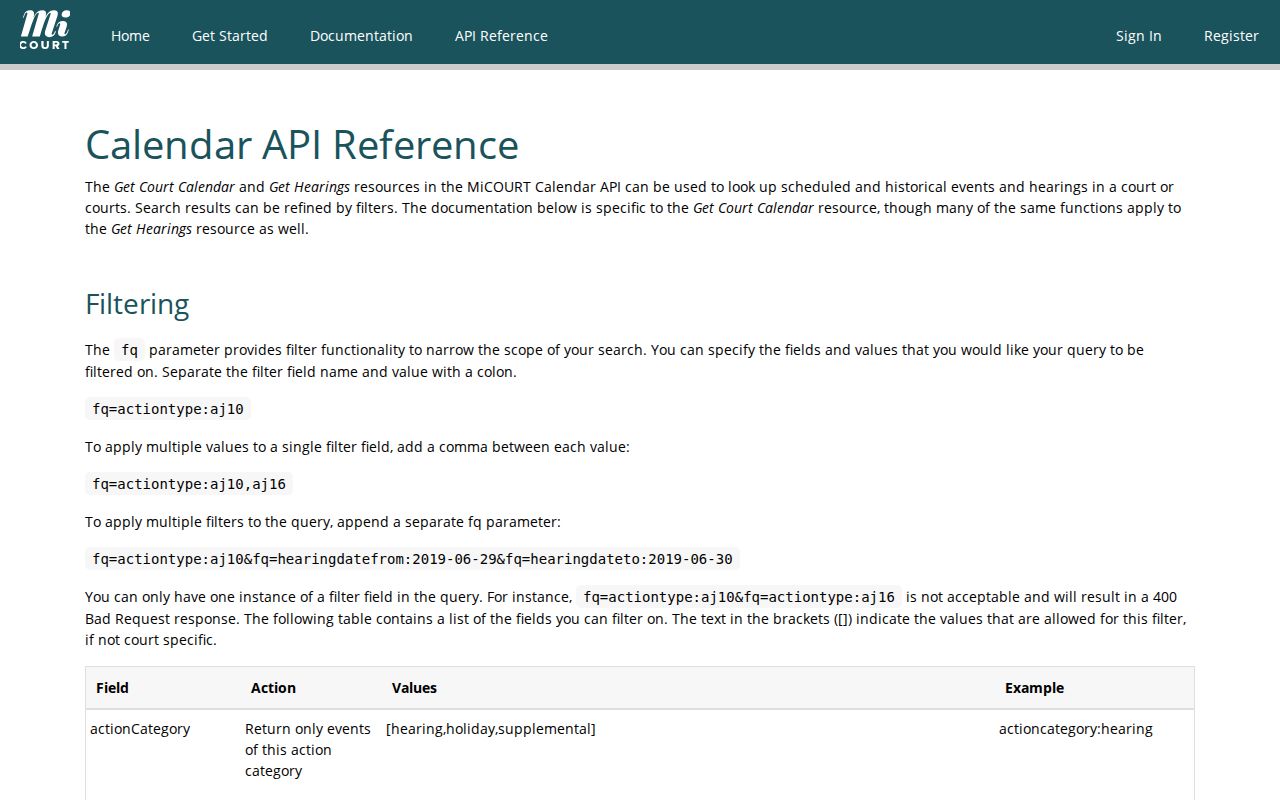
Those developer filters help explain the system's design. They do not guarantee every field shows up as a control on the public calendar card.
Kalkaska County Court Date Lookups
Work the channels in order. Compare any citation, notice, or case number against the online case history and calendar first. Then confirm with the division that owns the matter. Kalkaska posts no local docket-call subscription and no daily-calendar archive, so a printed page or an empty online day should never be mistaken for the full schedule.
- Start with the citation, prior notice, or last court order and copy the exact case or citation number, hearing date, and court division.
- Search MiCOURT Case Search by case number and year, or by participant name, then note the visible date, time, hearing type, court, and case events.
- Open the MiCOURT public calendar for the date and compare its case number or CTN, time, and hearing information with the case view.
- Use the calendar's previous-day, next-day, Today, Card, Table, and Print controls to check nearby dates when a reset is suspected; the Print control is not a published daily archive.
- Use the Kalkaska court contacts and local instructions to reach the owning division. District is 231-258-9031, Circuit Clerk is 231-258-3349 with office route 231-258-3300, Family is 231-258-3314, and Probate is 231-258-3330.
- Visit the proper clerk counter at 605 N Birch during posted weekday hours when the online record is unclear. Ask whether a courthouse posting or public terminal is available, because no current online terminal policy or daily posting archive was found.
- For historical calendar material, ask the clerk for a calendar printout, docket entries, or signed orders with a date range, division or judge, and case number. Mail or fax procedures require current clerk confirmation.
Kalkaska Calendar Versus Notice
Three documents get confused for each other, and they are not the same thing. A calendar card helps you locate a public setting and its CTN. The case docket tells a chronological story. Around that setting, it may show a notice of hearing, an adjournment, a hearing held, a later order. The signed order or official notice is what actually controls your obligation to appear. The differences matter most when the three sources disagree. When a calendar date has changed, compare adjacent dates and the case history first. Then ask the clerk whether the matter moved, switched divisions, or became nonpublic. A missing entry has several possible causes. It could mean a reset, the wrong display date, a protected matter, a different division, or an event that has not indexed yet. It is not reliable proof of cancellation. Privacy limits shape Kalkaska public calendar access too. MiCOURT excludes or suppresses many protected categories, juvenile and child-protective proceedings among them, and masks protected personal information in its public displays. Probate and family records can hold protected material. That can hold true even when a category or status stays visible. If a calendar result is absent, identify the likely division. Try the exact case number and year. Then ask only whether a lawful public version, a redacted copy, or a court-directed procedure exists. Never use the calendar to guess at information the court has deliberately withheld.
Court Settings: What Each Field Means
Read a public Kalkaska setting as a set of matching details, not a bare date. Check the date against the right case first. Then compare the time, the hearing description, the court, and the CTN. Courtroom or judge information appears when it is public. If an assignment changes, the case record and the clerk still matter. Keep in mind that a setting can be a procedural event rather than a trial. That is why the hearing description carries weight.
| Date | The calendar day selected for a public setting. Check nearby dates after an adjournment or reset. |
|---|---|
| Time | The displayed scheduled time for the public entry. Confirm it with the notice or clerk if it matters. |
| Hearing Info | The public action or hearing description, such as a motion hearing, pretrial, plea, sentencing, or trial. |
| Case Number | The public case identifier used to match the calendar card to the docket or register. |
| CTN | The court tracking or reference number displayed by the public calendar. |
| Courtroom or judge | Public assignment details where displayed; confirm changes with the clerk or coordinator. |
Kalkaska Calendar Setting Terms
Hearing information often carries terms that explain why a date exists. An arraignment is the formal criminal appearance. It covers charges, rights, plea or bond procedure, and next steps. A preliminary examination is the District probable-cause stage that can precede a felony bindover. A pretrial handles case management before trial. A motion hearing addresses a request for a court ruling. An informal civil-infraction hearing puts the matter before a magistrate, with no attorneys, in the informal track.
- Adjourned or reset
- The original setting moved to a later date, so the old date should not be relied on.
- Show cause
- A hearing requiring a person to address alleged noncompliance, including a probation issue.
- Status or conference
- An administrative or case-management event that may not be a trial setting.
- FOC appointment
- A Friend of the Court event that is not necessarily a public trial-court hearing.
The local Kalkaska glossary is a useful local terminology reference.
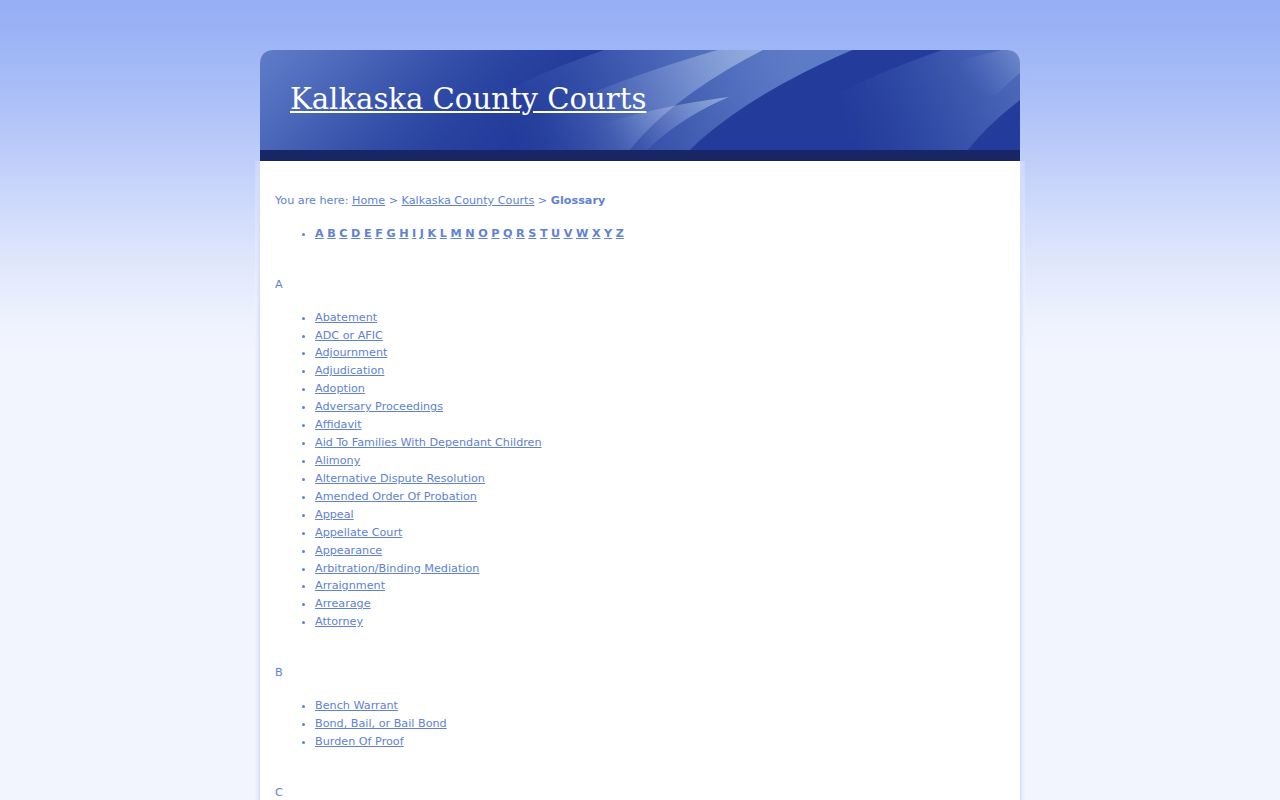
Go by the term printed on the case record or calendar. Then ask the correct division what the setting actually requires.
When a Court Date Moves
A continuance, adjournment, or reset shifts a hearing to a new day. The stale date often stays in the case history, so the next Kalkaska County setting may sit somewhere else entirely. Circuit calendars are the tricky ones. The public calendar does not list every Circuit proceeding. Judges Mertz and Hunter carry assignment numbers tied to Gaylord and Grayling. The Kalkaska clerk counter remains the contact for the case record itself. Never treat a vanished entry as a cancellation. Read the case history and scan the calendar dates around it. Then call the division before you drive anywhere. Ask if the date still stands, whether the courtroom or judge changed, and whether a new notice, accommodation, interpreter, or remote-appearance instruction now applies.
Kalkaska Calendar Reset Checks
Keep a reset question narrow and it gets answered faster. Hand the clerk the case number, the division, the former date, and whatever hearing information you saw online. Then say what you actually want. Choose a current public setting, a historical calendar entry, docket events, or a signed order. That distinction lets the clerk search the right record. A blank calendar day is not a final answer.
MiCOURT's documented calendar vocabulary covers hearing, holiday, and supplemental action categories. It also covers courtroom, judge, case category, and date or time ranges. Those labels describe the system. They do not promise a matching public display filter. That is why an online entry can carry a different scope than the question a clerk resolves.
Missed Settings and What Comes Next
Act quickly after a missed Kalkaska County hearing. Confirm the case number and division first. Review any public docket event. Then contact the clerk who owns the case for the current status and any new date. Consequences of a missed setting vary with the case and the court action involved. A calendar card alone cannot tell you the result. When you need legal representation, a licensed attorney can advise on your individual matter.
Missed a setting? A bench warrant is a warrant issued by a judge, commonly after failure to appear or comply.
Contact the District, Circuit, Family, or Probate division promptly to determine the current court instruction and whether a new setting exists.
Use the signed order or official notice and clerk confirmation rather than relying on an old or blank public calendar entry.
Kalkaska Calendar Clerk Requests
The clerk route also matters for Probate and Family calendar questions. Probate answers at 231-258-3330, Family at 231-258-3314, and Friend of the Court at 231-258-9744. The local court provides hearing-impaired equipment when requested through the clerk. Arrange that help before the setting arrives. A public-record request for calendar history goes smoother when you specify the date range, the division or judge, and the case number. Say whether you want a calendar printout, docket entries, or signed orders.
For division-specific instructions, the official Kalkaska Probate Division page shows what that office handles.
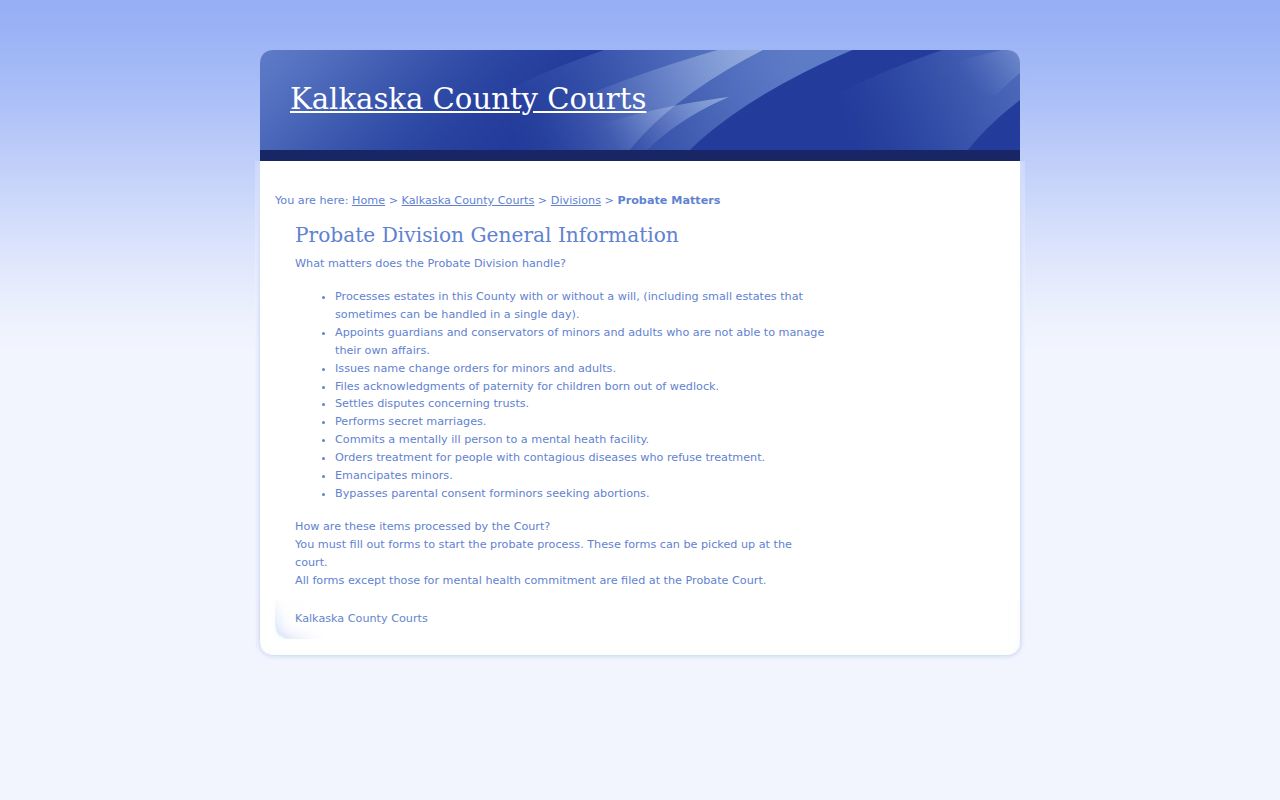
Kalkaska Calendar Clerk Requests: Division-specific procedure helps route a calendar question to the office that keeps the underlying case record.