
Kalkaska County Civil Docket Searches
Begin at MiCOURT Case Search, the public entry point for a Kalkaska civil docket. Pick Name Search for a person or business. Pick Case Number Search when you have the number and its four-digit case year. The last-name or business field needs at least two characters. For a Circuit civil matter, Civil is the helpful category. Domestic and family matters can sit inside Civil rather than under their own tab. Status filters trim results to open or pending, adjudicated or disposed, and closed cases.
Keep the court division in mind. MiCOURT is a statewide public layer rather than the clerk's complete civil file. A result names the court, filing year, category, status, and visible events. When something is missing, turn to the local civil instructions, the public calendar, or the division that holds the record. The older Kalkaska civil matters page still explains local procedure well. It is not proof an unlisted case never existed.
- Open MiCOURT and select Name Search or Case Number Search.
- Enter an exact last name, or enter the case number with its four-digit year.
- Select Civil and add a status or filed-date range only when it helps narrow the result.
- Open the matching public case and record its court, number, filing year, status, and visible events.
- Use the correct clerk division for a document, a certified copy, or a question about a missing civil entry.
Kalkaska MiCOURT Civil Search
A narrow start works best. First and middle name are optional here. A four-digit birth year can separate similar names when you lawfully know it. The portal takes a bounded filed-date range, and dates follow the yyyy-mm-dd format. Its categories and public status labels help you locate public case metadata. So does its pagination. There is no public bulk-download route. Some results are excluded, suppressed, not yet indexed, or limited to the visible case history. The official MiFILE login shows the account-based filing path that eligible filers use.
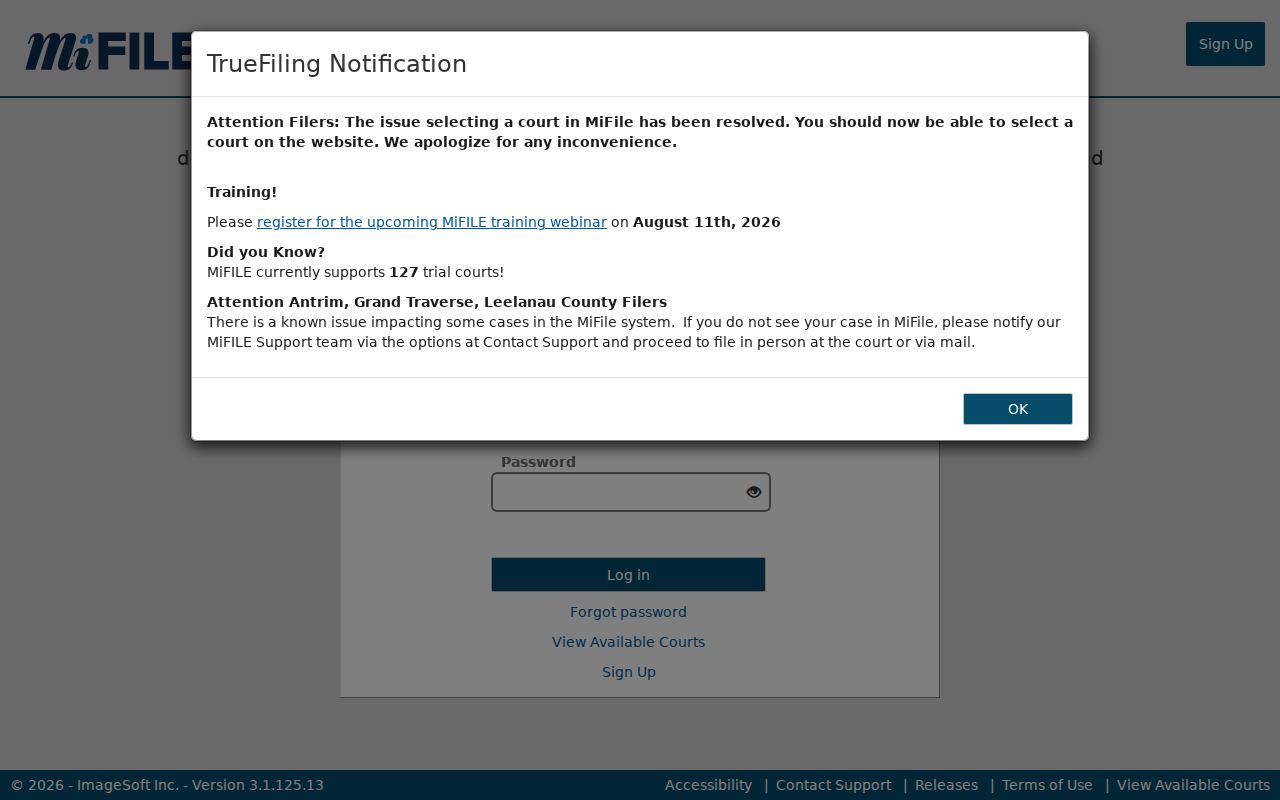
MiFILE supports filing work, but its filer workspace is not an anonymous public civil docket. It also does not replace MiCOURT Case Search.
Civil Dockets: What They Show
A Kalkaska County civil docket is a chronological case history. It is sometimes called a register of actions. It indexes activity; it does not automatically deliver every pleading or order. From the public record you can learn party roles, the claim category, the court and division, the filing date, public status, and the docket sequence. Read that sequence for the complaint or petition, summons and proof of service, answer, motions, notices, mediation or ADR activity, hearings, an adjournment or reset, judgment or order, garnishment, satisfaction, and any notice of appeal.
| Case number and year | The public identifier used with the filing year to locate the Kalkaska civil case. |
|---|---|
| Court and category | The division, civil category or subcategory, and public status shown for the case. |
| Parties and claim | Plaintiff or petitioner and defendant or respondent roles, with claim information when public. |
| Case events | Dated filings, service, motions, notices, hearings, orders, judgments, and later collection events. |
| Setting details | Date, time, hearing information, case number, CTN, and public courtroom or judge details where displayed. |
| Documents and result | A status label or event can point to a result, but the signed order or certified copy may need a clerk request. |
Kalkaska Civil Court Divide
Civil routing in Kalkaska follows one practical line. The 87-B District Court District Division hears civil claims of $25,000 or less. The 46th Circuit Court Circuit Division takes claims greater than $25,000. It also takes all equitable relief. Equitable relief means asking the court for action other than money damages, such as an injunction. A claim's amount points to the right starting division. Yet it does not fold every related case into one docket. Venue may also depend on a defendant's residence, business, registered office, or the place where the action arose. The official local civil guidance outlines how District and Circuit split the work.
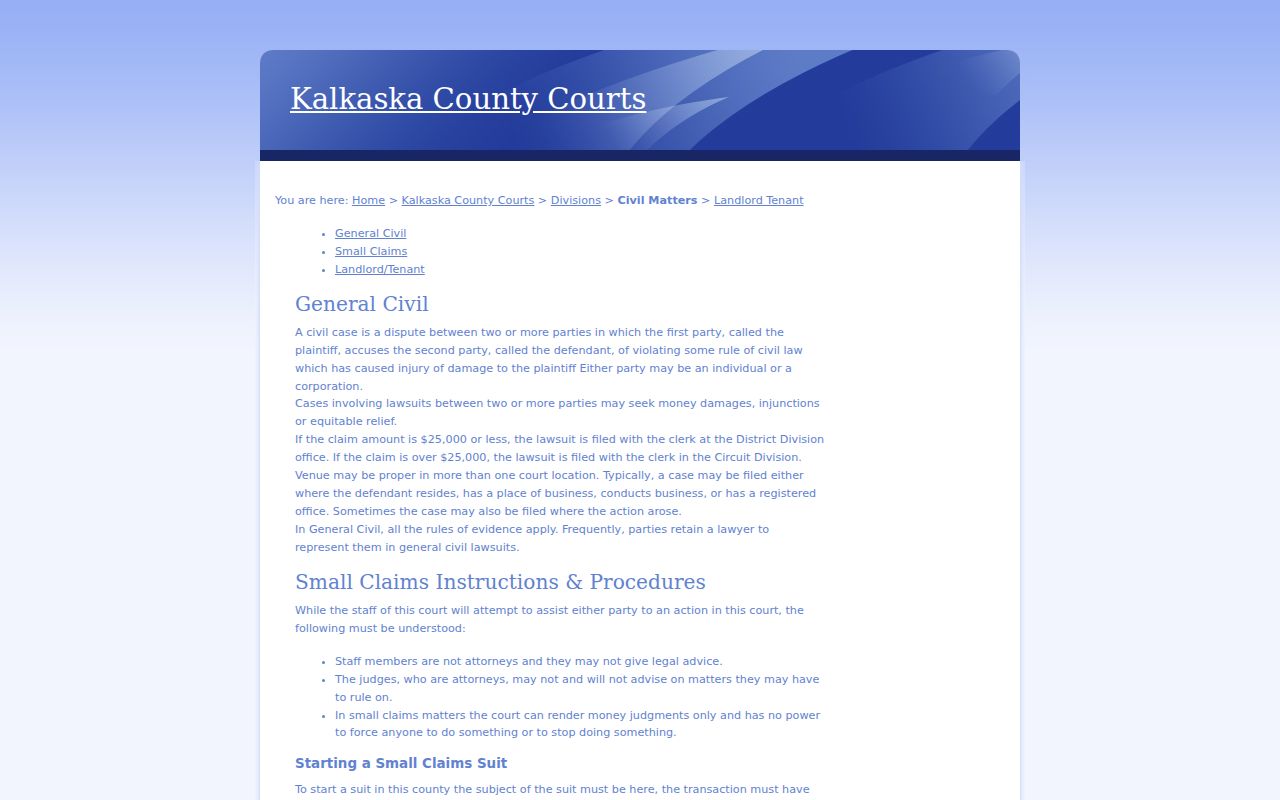
That split tells you whom to call when a civil docket needs confirmation. Reach the District Division or the Circuit Court Clerk, depending on the case.
| Starting court | Civil docket scope | Local contact route |
|---|---|---|
| 87-B District Division | Claims of $25,000 or less and small claims | District counter, 605 N Birch, or 231-258-9031 |
| 46th Circuit Division | Claims over $25,000 and equitable relief | Circuit Court Clerk, 231-258-3349 or office route 231-258-3300 |
What Cases Fill the Civil Docket
Civil Court Dockets in Kalkaska hold general civil claims and small-claims matters. They also hold public domestic or family-related records that the statewide interface labels Civil. The Circuit Division also handles divorce and other family matters. Probate keeps its own records path. Even so, read every public Civil result against the court field and the category. A matching name does not settle the case type. And a document image is not guaranteed just because a result appears.
- General civil claims for money damages within the court's jurisdiction
- Small-claims cases seeking a money judgment only
- Higher-value Circuit civil claims and requests for equitable relief
- Public domestic or family category results shown through the Civil filter
- Post-judgment docket activity such as garnishment, satisfaction, or appeal
The official filing and payments page shows the local route to filing resources, including small-claims e-filing.
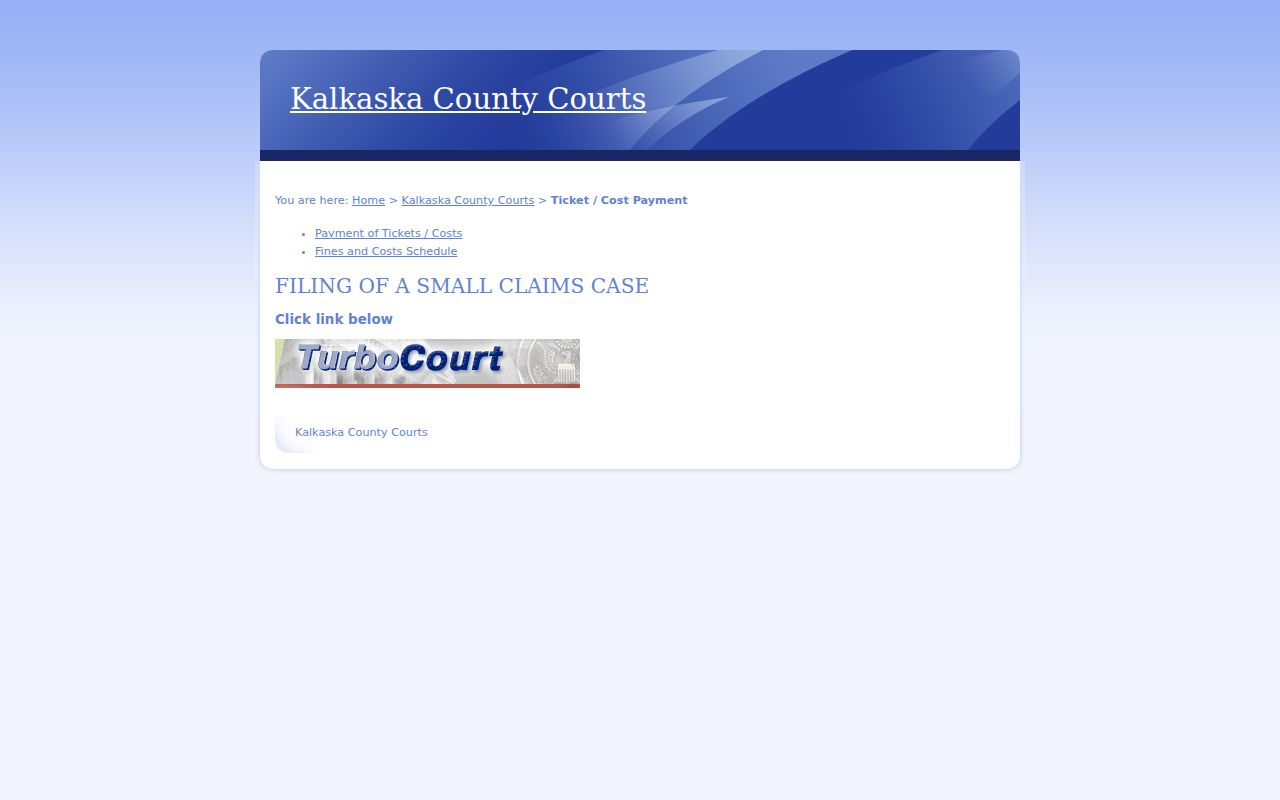
Filing links can help an eligible party start a matter. Still, a payment or filing screen is not a public record search.
Kalkaska Small Claims Limits
Small claims runs through the District process in Kalkaska County. It exists for one thing: a money judgment. It cannot force anyone to act or stop acting. The local small-claims material describes a proceeding with no attorney, no jury, and no appeal. A defendant can also refuse the small-claims route, which pushes the case into general civil. When that happens, track the new or general-civil case number. Ask the District Division whether the old caption stays linked to the file.
Watch the numbers on the older Kalkaska page. It states a $3,000 small-claims maximum, but that figure is dated. Current Michigan law raised the statewide limit. Treat it as history, not as the current filing limit. Before filing anything, confirm the statutory limit, the forms, service instructions, and the filing fee with the District Division. The local material says hearings are commonly set about three to four weeks out. It describes seven-day notice, though current timing should also be confirmed.
Hearings on the Civil Docket
A civil setting carries many labels in the case history. Status conference, motion hearing, mediation or ADR event, hearing, adjournment, judgment, or order all appear there. The MiCOURT public calendar can display a date, time, and hearing information. Case number and CTN appear for public entries. A calendar card is not the full civil docket. Compare any setting against the case history itself.
A public date can be missing for several reasons. It may be a nonpublic case, or a matter sitting in another division. The hearing could be reset, the entry not yet indexed, or the date outside the displayed window. When the date truly matters, trust the court's signed notice or order plus confirmation from the proper clerk. The Kalkaska County Court Schedule lays out how to confirm dates through public calendar entries, clerk calls, and moved settings.
Kalkaska Civil Status Traps
A visible status helps. It never replaces the underlying civil record. A label like "Closed," "disposed," or "default" may describe a system status or a single docket event. That label says nothing about the full terms of a signed judgment, dismissal, satisfaction, or order. A default entry does not settle that question. It does not establish that a final signed judgment is available in the public card. A small-claims judgment is one thing. A certified copy of that judgment is another.
Public access can also stop at metadata or a redacted history. Protected personal information gets masked. A civil result may carry a nonpublic attachment. When a needed result is absent, ask the correct division whether the item is excluded, suppressed, sealed, protected, not yet indexed, or held in another court division. Frame the request around the case number, division, event or document, and date range. That approach works far better than asking staff to reconstruct hidden information.
Who Can See Civil Dockets
Court-record access rules govern Michigan court records. Anyone may inspect public civil case history, subject to protected-record exceptions. The online docket is a convenience. It is not a promise that every public record is online. Inspection is also different from copying. No current local civil copy amount exists, so assume no fee; instead, ask for the current plain-copy or certification charge before payment. When a protected document is involved, request a redacted public version.
Michigan civil-record rules.
MCR 8.119 sets the public-access, inspection, reproduction, and charge framework for court records.
MCR 1.109 governs court records and electronic case data, including its public-access connection.
MCL 600.1988 bars a charge to retrieve and inspect a document on site while allowing copying charges under the governing rules.
Kalkaska Civil Copy Requests
A public civil docket, a document, or a certified record all come from one place. Go to the court of record. The District Division handles small claims and general civil matters at 605 N Birch, 231-258-9031. Larger civil claims and equitable relief go through the Circuit Court Clerk at 231-258-3349. The number 231-258-3300 is also listed as an office route. The current Kalkaska court contacts identify the division routes. In-person inspection is available during posted weekday hours, excluding closures. Confirm any mail or fax procedures with the division. The court offers no universal email, online records form, or public-terminal policy; ask the clerk about a terminal and get a fee quote before payment.
One more boundary matters here. Kalkaska state civil dockets do not include federal bankruptcy cases. Those live in a separate federal court system, reached through the official bankruptcy court portal.
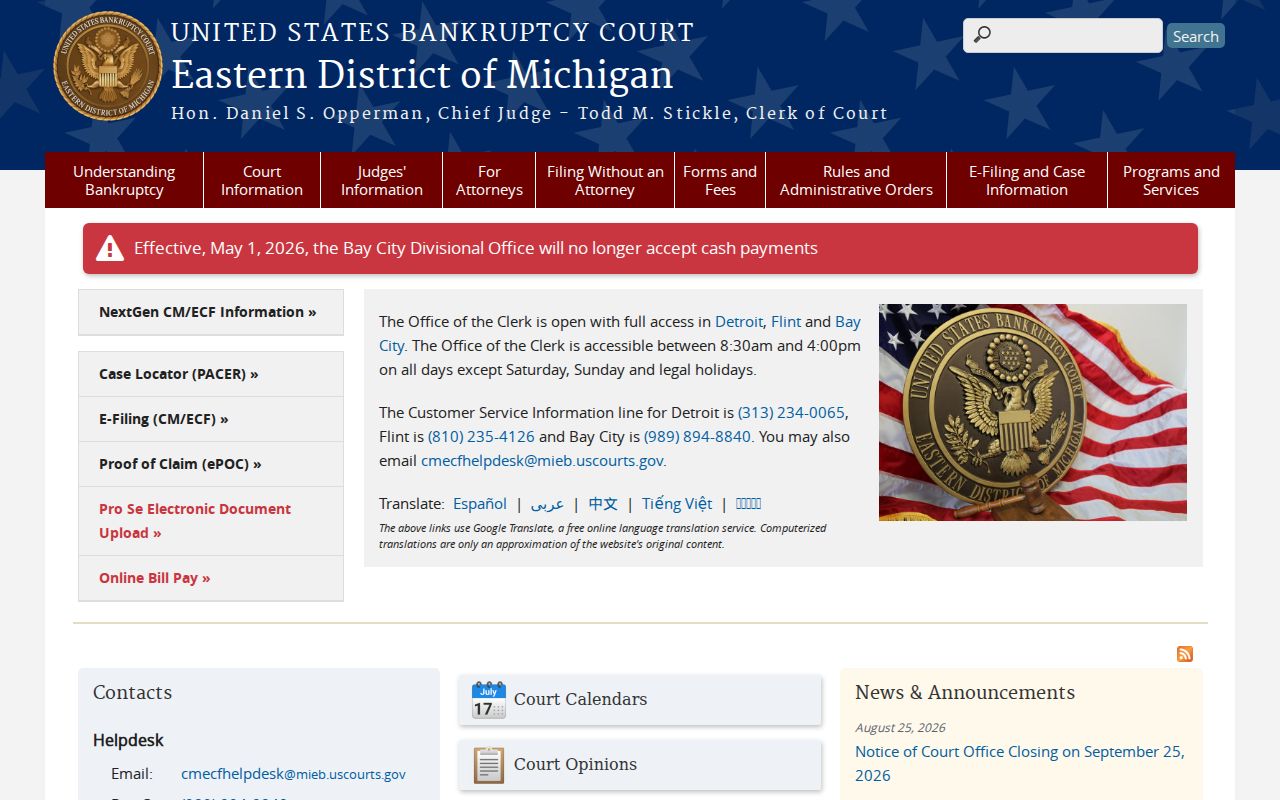
That federal portal cannot substitute for the local District or Circuit clerk. If the record belongs in a Kalkaska County state-court civil file, request it from the court that holds the file.